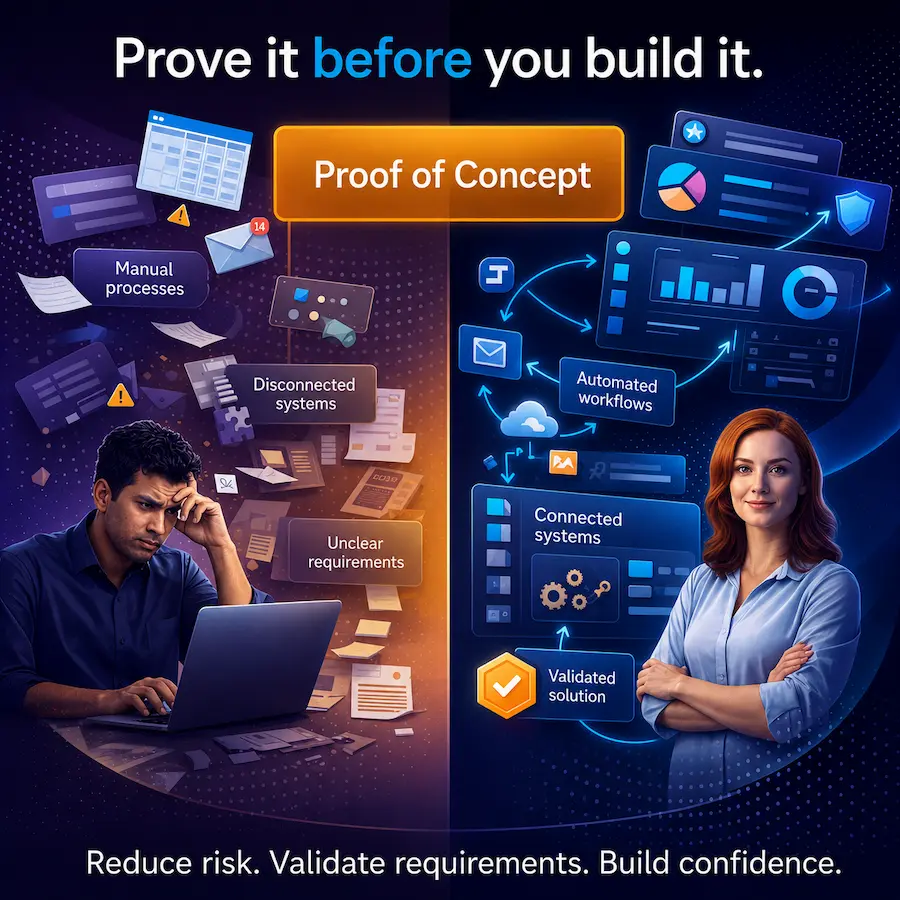
You’ve identified a problem in your business.
Perhaps your team is battling spreadsheets. Information is duplicated across systems. Reporting takes days instead of minutes. Or maybe you’re excited about the potential of AI but unsure whether it will genuinely deliver value.
You know something needs to change.
The challenge is knowing whether the solution you’ve been shown will actually work in your business.
That’s where a Proof of Concept (POC) comes in.
At Avrion, we’ve found that a well-structured Proof of Concept is one of the most effective ways to reduce risk, build confidence and ensure technology investments succeed.
In fact, we’ve increasingly adopted POCs as a key stage between discovery and full implementation because they help everyone make better decisions.
Key Takeaways
Proof of Concept (POC): The Smart Way to Reduce Project Risk
Before investing in a CRM, software platform, automation project or AI initiative, a Proof of Concept helps you replace assumptions with evidence.
The key benefits of a POC are:
- Reduced risk: Validate that the solution will deliver the outcomes you need before committing to a full implementation.
- Faster decision-making: A working prototype helps stakeholders understand the opportunity far more quickly than proposals and presentations alone.
- Clearer requirements: Identify gaps, challenges and opportunities early, before they become costly project changes.
- Stronger stakeholder buy-in: Users and decision-makers are more likely to support a project when they can see and interact with a real solution.
- Confidence for everyone involved: A POC provides assurance for both customer and supplier that the proposed solution is technically achievable, commercially viable and aligned with business goals.
- A practical route into AI and technology transformation: Explore new technologies on your terms, at a pace that works for your team, without making large upfront commitments.
The Bottom Line
A Proof of Concept isn’t an extra step in the process. It’s often the step that determines whether a technology project succeeds. By validating the solution before full delivery begins, organisations can make better decisions, reduce uncertainty and invest with confidence. Think of a POC as the bridge between a good idea and a successful implementation.
What is a Proof of Concept?
A Proof of Concept (POC) is a focused project designed to validate whether a proposed solution can achieve the outcomes you’re looking for.
Rather than relying on demonstrations, presentations or lengthy proposal documents, a POC allows you to see a working prototype that reflects your organisation’s processes, requirements and objectives.
Think of it as moving from theory to evidence.
The objective isn’t to build the final solution.
- The objective is to answer key questions such as:
- Will this solve our problem?
- Will our users adopt it?
- Can it integrate with our existing systems?
- Are our assumptions correct?
- Is this investment worth pursuing?
By answering these questions early, organisations can move forward with far greater confidence.
Why Not Just Go Straight to a Full Project?
It’s a fair question.
Many organisations spend weeks or months gathering requirements, reviewing proposals and analysing costs before a project starts.
The problem is that until people can see and interact with something tangible, assumptions often remain hidden.
That’s where projects can run into difficulty.
A POC allows you to validate the scope before committing to a larger investment.
It helps identify misunderstandings, refine requirements and create clarity around what success looks like.
In many cases, we can demonstrate a significant proportion of the proposed solution during the POC phase, allowing stakeholders to visualise the outcome before full development begins.
Why We Describe a POC as “Insurance”
One phrase that regularly comes up in conversations with our team is this:
A POC is insurance for both you, the customer, and the supplier.
For customers, that insurance means:
- Confidence that the solution will meet business requirements
- Reduced implementation risk
- Greater certainty around costs and outcomes
- Stakeholder reassurance before approving budgets
For Avrion, it means:
- Validating technical feasibility
- Confirming commercial viability
- Ensuring the proposed approach is the right fit
- Creating a clear delivery roadmap
Ultimately, both sides gain confidence before making bigger commitments.
What Happens During a POC?
Every engagement is different, but most Avrion Proof of Concepts follow a similar process.
1. Discovery and Business Review
We begin by understanding your business, processes, challenges and objectives.
The focus is on identifying operational friction and opportunities for improvement.
2. Scoping and Prioritisation
Together, we determine which processes, integrations, reports or workflows need to be validated.
Not everything needs to be built.
Only the areas that matter most to your decision-making process.
3. Prototype Development
Our consultants create a working prototype that demonstrates how the proposed solution could operate.
Depending on the project, this may include:
- CRM functionality
- Process automation
- Customer portals
- Reporting dashboards
- AI-powered solutions
- System integrations
4. Demonstration and Feedback
Stakeholders review the prototype, provide feedback and help refine requirements.
This stage often uncovers valuable insights that would otherwise emerge much later in a project.
5. Roadmap and Recommendation
Following validation, we provide a clear implementation plan together with project recommendations, priorities and budget guidance.
Why Are POCs Paid Engagements?
This is one of the most common questions we hear.
Some organisations expect extensive discovery and solution design to be included as part of a free sales process.
Our experience suggests this rarely benefits either party.
Paid POCs create commitment and focus.
When customers invest in a POC:
- Decision-makers become actively involved
- Requirements are explored in greater depth
- Stakeholders remain engaged throughout the process
- Both parties have a shared interest in achieving a successful outcome
It also allows us to invest the time needed to create something genuinely useful, rather than producing generic proposal documents.
The result is a stronger business case and a higher likelihood of project success.
How POCs Help with AI Adoption
AI is currently one of the most discussed business technologies.
It’s also one of the most misunderstood.
Many organisations know AI has potential but aren’t sure where to start or whether it will provide meaningful returns.
A Proof of Concept provides a practical and low-risk route into AI.
Rather than committing to a large AI programme, organisations can:
- Identify a genuine business challenge
- Build a targeted AI prototype
- Test the outcomes
- Measure the value
- Decide whether wider adoption makes sense
This keeps investment focused and ensures decisions are based on evidence rather than hype.
A Real Example
One of our most successful recent Proof of Concept projects was delivered for a building contractor and refurbishment specialist.
The POC focused on key operational areas including:
- Tender management
- Project initiation
- Project management
- Commercial tracking
- Subcontractor management
- Reporting and financial visibility
- Future integration concepts with Sage 50
Rather than discussing requirements for months, stakeholders were able to see how the solution would work in practice.
The approach validated the scope, increased stakeholder engagement and ultimately led to approval for a full implementation project.
Even more importantly, additional opportunities for future phases of work were identified during the process.
That’s exactly what a successful POC should do.
It reduces uncertainty and creates a clear path forward.
The Future of Technology Projects
Technology projects are changing.
Advances in low-code platforms, Microsoft technologies and AI-powered development tools mean organisations no longer need to rely solely on lengthy specifications and assumptions.
Today, businesses can see solutions much earlier in the process.
That’s good news for everyone.
A Proof of Concept helps you make informed decisions, reduce risk and ensure your investment is aligned with your business goals before committing to full implementation.
And in our experience, that leads to better outcomes every time.
Frequently Asked Questions
What does POC stand for?
POC stands for Proof of Concept. It is a structured exercise used to validate whether a proposed solution can meet business requirements before a full project begins.
How is a Proof of Concept different from a demo?
A software demonstration shows what a product can do.
A Proof of Concept demonstrates how a solution could work in your business, using your processes, requirements and objectives.
How long does a POC take?
The duration varies depending on scope and complexity. Most POCs focus on validating key processes and outcomes rather than delivering a complete solution.
Is a POC the same as a pilot project?
No.
A POC tests feasibility and validates the concept.
A pilot project typically involves deploying a near-complete solution to a defined group of users.
What types of projects benefit from a POC?
POCs work particularly well for:
- CRM implementations
- Business software projects
- Automation initiatives
- Customer portals
- System integrations
- Data and reporting projects
- AI solutions
What are the biggest benefits of a POC?
The key benefits include:
- Reduced project risk
- Better stakeholder buy-in
- Faster decision-making
- Clearer requirements
- Greater confidence in investment decisions
Should a POC be paid?
In our experience, yes.
Paid POCs create commitment from both parties, provide access to decision-makers and ensure sufficient time is invested in creating meaningful outputs that support successful project delivery.
Our commitment to you is that Avrion’s POCs are 50% of our usual rates.
What happens after a POC?
Once the POC has been validated, the next step is usually a full implementation project with clearly defined scope, costs, timescales and priorities.
Not sure whether your idea will work?
A Proof of Concept can help you validate the opportunity, reduce risk and build confidence before committing to a larger project.
Book a discovery call with Avrion and let’s explore what’s possible.