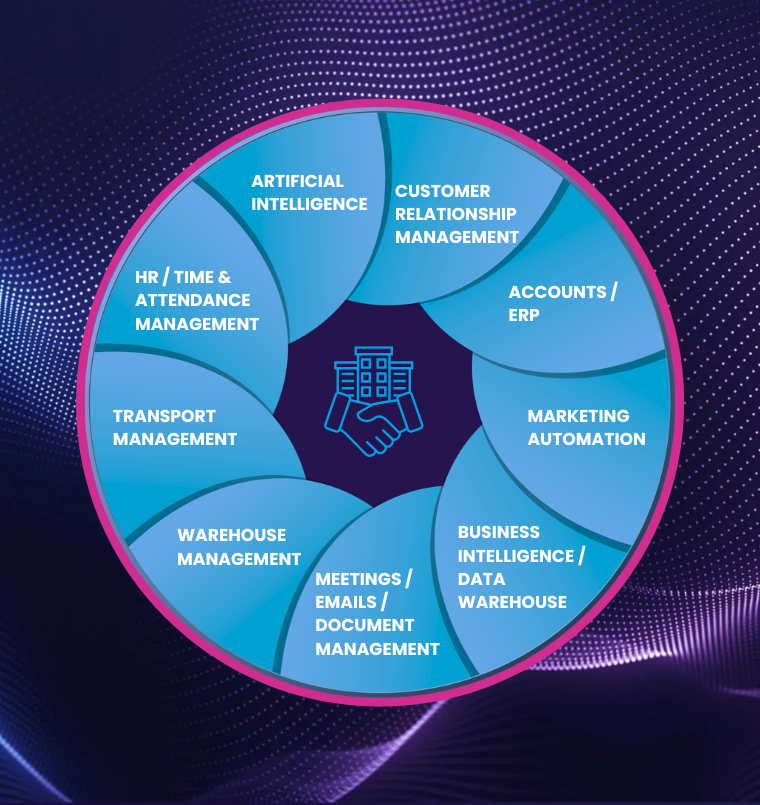
Disconnected software creates hidden costs through duplicate data entry, manual processes, reporting delays, inconsistent information and poor visibility. As businesses grow, disconnected systems increase administration, reduce efficiency and make it harder to benefit from automation and AI.
For many businesses growth happens gradually. A new CRM is introduced to support sales. Finance adopts a specialist accounting package. Operations invest in software tailored to their sector. Marketing adds its own tools to improve customer engagement. Individually, each system solves a problem. Together, they can create a new one.
Disconnected software is one of the most common barriers to productivity that we see when working with growing organisations. It often develops naturally over time, but the hidden costs can be significant. Teams spend hours manually transferring information between systems, searching for data, correcting errors and trying to establish a single version of the truth.
What looks like a technology issue is often a business performance issue.
The Cost You Don’t See
When systems don’t communicate effectively, employees become the integration layer.
A member of staff copies customer details from one system into another. An accounts administrator manually checks purchase orders against invoices. A customer service team member searches multiple platforms before replying to a query.
These tasks may only take a few minutes each time, but across an entire business they quickly add up. More importantly, they divert talented people away from higher-value work such as building customer relationships, driving innovation and solving business challenges.
The challenge becomes even greater as organisations grow. More customers, suppliers and transactions generate more data. Without connected systems, businesses often find themselves adding headcount simply to manage administration rather than creating additional value.
One business was processing between 1,000 and 1,500 supplier emails every week. Each message contained invoices and compliance documentation that had to be validated, matched against purchase orders and uploaded to customer portals. Managing the process required the equivalent of three to four full-time employees, with mistakes and delays becoming increasingly costly.
How Disconnected Systems Impact Decision Making
Another hidden cost of disconnected software is unreliable data.
Most business leaders want better visibility of performance, whether that’s revenue forecasts, customer service metrics, operational efficiency or profitability. However, accurate reporting becomes difficult when information exists across multiple systems that aren’t connected.
Different departments may be working with different figures. Reports take longer to produce. Decision-making slows down because leaders lack confidence in the information available.
Trusted data is essential for making faster and more effective decisions. The organisations that benefitted most from automation weren’t simply reducing workload; they were creating more reliable data that could be used confidently across the business.
Market conditions can change rapidly, the ability to make informed decisions quickly is becoming a competitive advantage.
Why AI Depends on Connected Data
Many organisations are understandably excited about artificial intelligence. The opportunity to automate repetitive tasks, improve customer experience and unlock new insights is compelling.
However, AI is only as effective as the data it can access.
One of the key messages from a recent event we sponsored was that successful AI adoption starts with good data foundations. Businesses are encouraged to ask themselves important questions: Where could AI save time? Are manual processes slowing the organisation down? Could smarter systems improve decision-making?
If customer information resides in one system, financial data in another and operational data somewhere else, AI tools face the same challenges as employees. They cannot deliver meaningful insights if the underlying information remains fragmented.
In other words, disconnected software limits both current performance and future innovation.
The Business Benefits of Integration
The good news is that the solution does not require replacing every system.
Modern integration platforms and automation tools can connect existing applications, allowing information to flow automatically between departments and processes.
The real benefits go far beyond efficiency:
- Less manual data entry
- Fewer errors and duplicated records
- Faster customer response times
- Improved compliance and auditability
- Better reporting and business intelligence
- Increased scalability without proportional increases in staffing
- Stronger foundations for AI and automation
The practical outcomes can be transformational. One of our projects achieved automated processing for 82% of supplier emails, freeing employees to focus on supplier relationships and customer service while improving data accuracy and consistency.
Another organisation used AI-powered inbox triage to automatically understand customer enquiries, retrieve relevant information from multiple systems and draft responses for review, improving response times without increasing headcount.
Preparing for a Data-Driven Future
The question is no longer whether data matters. The question is whether your systems are enabling you to make the most of it.
As businesses adopt AI, automation and increasingly data-driven ways of working, disconnected software becomes more than an inconvenience. It becomes a strategic obstacle.
The organisations that thrive over the next decade will be those that create connected, accessible and trusted data environments. They will spend less time managing information and more time acting on it.
The future belongs to organisations that embrace data-driven decisions. AI is not about replacing people; it is about empowering them. When systems are connected and data is trusted, your team can focus on what humans do best: creativity, empathy, relationships and strategy.
The future of data isn’t simply digital. It’s connected. And that’s where real business transformation begins.
Frequently Asked Questions
What is disconnected software?
Disconnected software refers to business systems that do not automatically share information, requiring employees to manually move data between platforms.
Why are disconnected systems a problem?
They create duplication, increase errors, reduce visibility and slow decision-making across the business.
How does integrated software improve efficiency?
Integrated software connects data and processes, reducing manual administration, improving reporting accuracy and helping teams work more effectively.
Why is connected data important for AI?
AI relies on accurate, accessible and connected data. Fragmented information limits the value AI can deliver.
Should businesses replace their existing systems?
Not necessarily. Many organisations can achieve significant benefits by integrating existing systems before considering replacement.